Everyone says risk off. Almost nobody says what they measured.
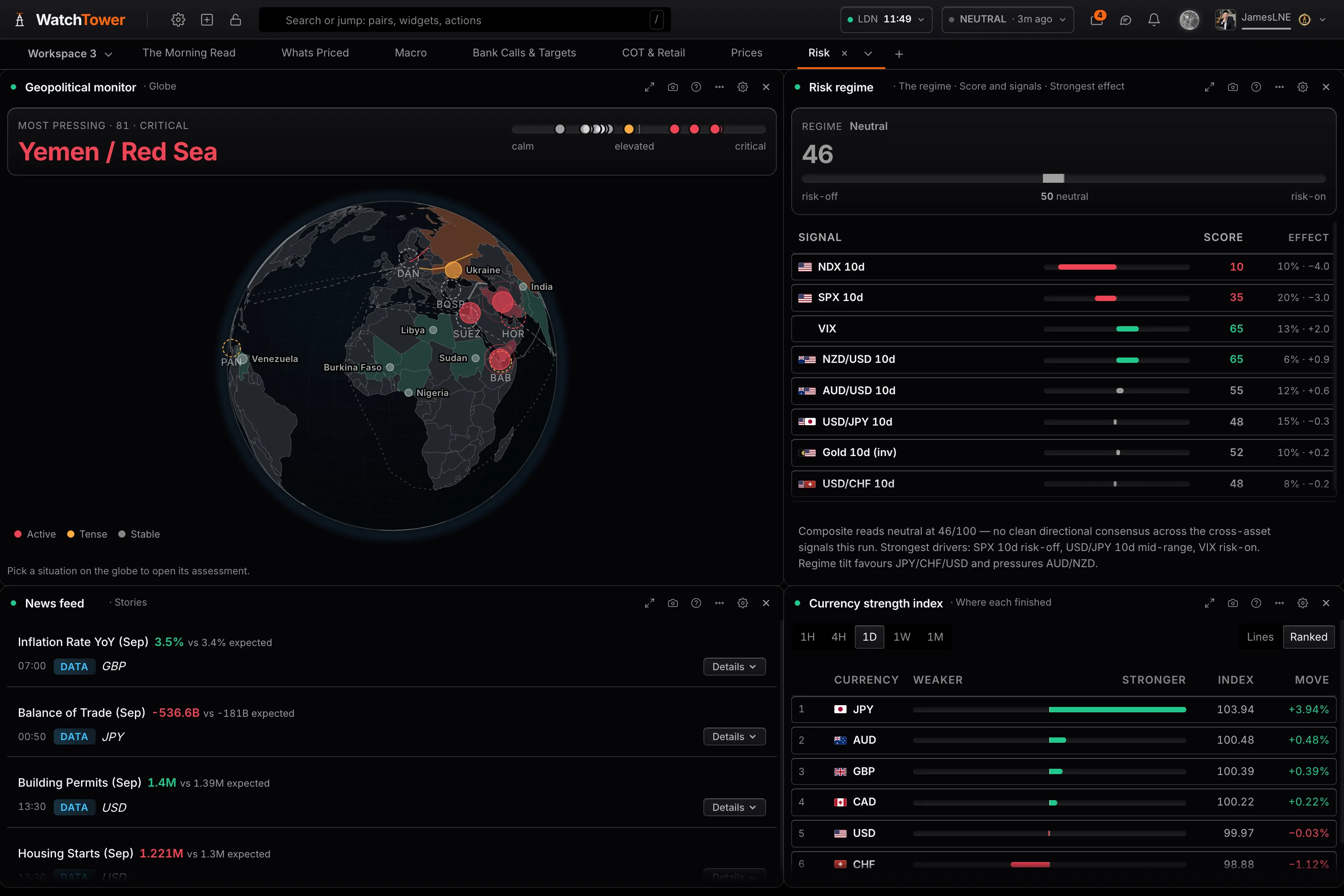
Risk on and risk off is the most used phrase in macro commentary and the least often derived. WatchTower's Risk regime panel builds the reading from cross-asset proxies and shows its working: every signal with what it contributes, and the raw prices underneath. When the composite and its own inputs start to disagree, that is worth more than either on its own. Risk regime is free.
Two reads
Different questions, different ways of being wrong.
The regime
- Asks
- Is capital moving toward risk or away from it?
- Built from
- Cross-asset proxies: the assets that lead when appetite turns, read together rather than one at a time, each signal shown with its weight and how far it pushes the reading.
- Where it fails
- It can lag a turn that starts in one asset class and has not spread yet.
The assets behind it
- Asks
- What are the inputs actually doing?
- Built from
- The raw prices the signals are built from (gold, crude, the yen, the franc and the commodity currencies) as prices, sparklines, a 24 hour heatmap or winners and losers.
- Where it fails
- Prices carry no weighting, so a move in one input has to be judged by eye against the rest.
They are two reads of one panel, the composite and the prices it is built from, so the reading can always be checked against its own inputs. A needle on its own would hide the moment that matters most: when one input has turned and the composite has not yet.
Depth
A needle, or the signals behind it.
Being straight about it
The geopolitical monitor does not predict anything.
Geopolitical monitor, a Pro panel, tracks situations that are already active, what they involve, and which currencies and commodities sit closest to them. Its 0 to 100 score is how much a situation matters to markets now. It does not forecast escalation, it does not score likelihood, and it will not tell you what happens next. Anything claiming to do that with a war or a sanctions regime is selling something.
What it is for is the connection most traders make too slowly: a situation develops, and the question is which of the markets on your board it actually touches.
The panels
Four panels.
- Risk regime. Free. Whether the market is risk-on or risk-off: the composite reading, every signal underneath it with what it contributes, and a written read on the regime. Switch to the assets behind it for the raw prices, sparklines, a 24 hour heatmap or winners and losers, so the reading can be checked against its own inputs.
- Geopolitical monitor. Pro. Live geopolitical and macro situations, scored 0 to 100 for how much each matters to markets now: ranked, on a 3D globe, by region, and which currencies escalation would push. Opening one gives what drives it, what it moves and the intelligence behind it.
- Asset in full. Pro. One asset in depth; its Research read carries the desk's full read, with the themes and geopolitical risks attached to that currency, so a theme is tied to something tradeable.
- Briefings. Free. Today's need-to-know with its watch items, for the mornings when there is time for one thing, alongside the session reports and the week's editorial.
Risk regime, answered.
What does risk on and risk off actually mean?
Whether capital is moving toward assets that pay more when things go well, or toward the ones that hold up when they do not. It is a description of flow rather than a forecast, and it matters in FX because some currencies are bought in one environment and sold in the other regardless of their own data.
How is the risk regime measured here?
From a set of cross-asset proxies read together rather than one at a time. Every signal is shown with its weight and how far it pushes the reading, so the composite can be taken apart and disagreed with. A gauge whose inputs are hidden is an assertion with a needle on it.
Why show the prices behind the regime?
Because a composite can lag a turn that starts in one asset class and has not spread yet, and the raw prices show it first. Risk regime carries both reads: the composite with its signals, and the assets behind it as prices, sparklines, a 24 hour heatmap or winners and losers. The Market regime layer on the Price chart is a different tool: it shades a chart by where the WatchTower score sat, bullish or bearish, and pins the events that moved it. That layer is Pro.
Does the geopolitical monitor predict escalation?
No. Geopolitical monitor tracks situations that are already active, what they involve, and which currencies and commodities sit closest to them. Each is scored 0 to 100 for how much it matters to markets now, a measure of relevance today with nothing to say about likelihood. It does not forecast what happens next, and anything claiming to would be selling you something.
Which currencies are most affected by risk sentiment?
Historically the ones with the strongest tendencies are the funding currencies on one side and the higher-beta commodity currencies on the other, but the terminal shows the current reading rather than relying on the historical tendency, because those relationships loosen and tighten over time.
Is it free?
Risk regime is free, with both of its reads, and so is Briefings. Geopolitical monitor, Asset in full and the Market regime layer on the Price chart are Pro, at $49 a month or $490 a year. The free plan carries 15 of the 49 panels across 2 boards, and every new account opens with 14 days of Pro, no card.