Market Structure
FX Trading Sessions and Liquidity
The FX market runs 24 hours, but it does not trade the same all day. Understanding the sessions and where liquidity concentrates changes how you read every move.
The currency market runs around the clock through the trading week, which is one of its defining features. It also traps people, because a 24-hour market does not trade the same way at every hour. Liquidity ebbs and flows through the day, and the same move means different things depending on when it happens. Understanding the sessions is basic market structure, and it changes how you read everything else.
The three sessions
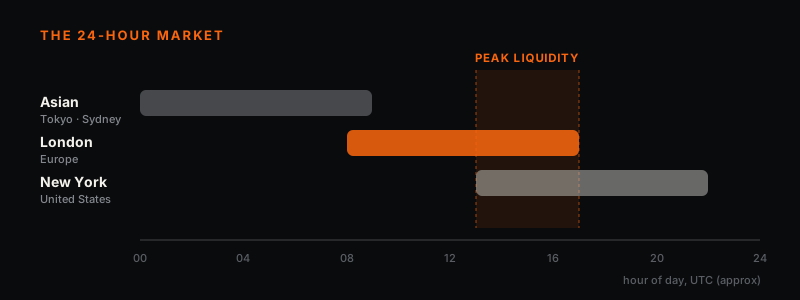
The trading day is usually split into three overlapping sessions, following the sun around the major financial centres.
The Asian session, centred on Tokyo and Sydney, opens the week’s trading day. It tends to be the quietest of the three, with the yen and the Australian and New Zealand dollars seeing the most activity, since their home markets are open.
The London session is the heavyweight. London is the largest FX trading centre in the world, and when it opens, volume and volatility step up sharply. The European currencies are most active here, and a large share of the day’s meaningful movement happens once London is in.
The New York session overlaps with the back half of London and carries the US data flow. The dollar and everything traded against it are most active through this window.
Liquidity is not constant
The single most important idea is that liquidity concentrates, and the peak is the London and New York overlap.
For a few hours each day, the two largest trading centres are open at the same time. This overlap is the deepest, most liquid window of the entire day, and it is where a large share of genuine volume trades. Spreads are tightest, order flow is heaviest, and moves that begin here tend to have real participation behind them.
Outside that window, liquidity thins out. The late New York hours and the early Asian session are the quiet stretches, and thin liquidity behaves differently. Moves can be exaggerated because it takes less flow to push price, spreads widen, and breaks of key levels are more prone to failing and reversing once real liquidity returns. A clean-looking breakout in a thin session deserves far more suspicion than the same break during the London and New York overlap.
Why this matters in practice
Knowing the session tells you what kind of tape you are dealing with.
It sets your expectation for movement. A quiet Asian session and the London and New York overlap are two completely different environments, and expecting the same behaviour from both is a mistake.
It flags when to distrust a move. A sharp break on thin late-session liquidity is far more likely to be noise or a stop-run than a break during peak hours with real volume behind it.
And it lines up with the data. The major economic releases cluster by session, European data in the London morning and US data in the New York morning, so the sessions tell you when the scheduled catalysts are most likely to land. That connects directly to how a currency reacts around events, which I covered in how to read a central bank meeting.
How I read it
Before I judge a move, I note which session produced it. A break during the London and New York overlap, with liquidity and often a catalyst behind it, gets my attention. The same break in a thin session gets scepticism until it survives into a more liquid window. I also keep in mind which currencies are naturally most active in the session I am watching, because a pair moving in its home session is a different thing from the same pair drifting in a foreign one.
This ties into the risk regime too, since thin-liquidity conditions can amplify a risk-off move, and into correlations, which can behave differently when only part of the world is trading.
In WatchTower Terminal I can mark the sessions directly on the chart, so I always know which part of the day a move belongs to rather than reading a level in isolation.
The market never closes during the week, but it is not equally alive at every hour. Knowing when the real liquidity is trading is one of the simplest edges available, and one of the most overlooked.
Reading this is one thing. Seeing it live is another.
The composite score on 24 markets, positioning across 44, and the research consensus behind them. 12 boards free, no card.