Market Structure
Currency Correlations: Why Pairs Move Together
Currency pairs are not independent. Understanding which ones move together, which move opposite, and why it changes in a panic keeps you from stacking the same bet.
Currency pairs are not independent of each other. Some move almost in lockstep, others move in near-perfect opposition, and the relationships shift depending on what is driving the market. If you trade several pairs without understanding how they relate, you can end up holding what looks like a diversified book but is really one big bet in disguise. Here is how I think about correlation.
What correlation actually measures
Correlation describes how two pairs tend to move relative to each other, on a scale from plus one to minus one. A correlation near plus one means they generally move in the same direction at the same time. A correlation near minus one means they move in opposite directions. A correlation near zero means there is no reliable relationship, and they wander independently.
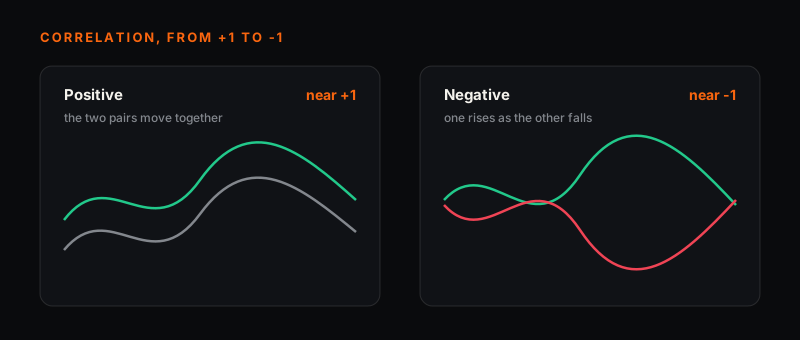
The number is a tendency measured over some window, never a guarantee for any single day. What matters is understanding why the relationship exists, because that tells you when it will hold and when it will break.
Why correlations exist
Correlations come from shared drivers. Two pairs move together because something they have in common is pushing them.
The most obvious case is a shared currency. Pairs that both trade against the dollar will often move together simply because a broad dollar move pushes all of them at once. When the dollar rallies across the board, a whole row of pairs turns the same colour, and that shared dollar leg is doing the work.
Commodity currencies are another case. Currencies of major commodity exporters tend to track the commodities they depend on, so they correlate with each other and with the underlying commodity price. And risk-sensitive currencies move together because they share exposure to the market’s appetite for risk, rising together when the mood is good and falling together when it turns.
Why it matters in practice
Correlation is most useful for two things.
The first is avoiding hidden concentration. If I am long three different pairs that are all really expressions of a weak dollar, I do not have three trades. I have one dollar trade in three costumes, and three times the exposure to a single dollar reversal. Knowing the correlations stops me from fooling myself about how diversified a book actually is.
The second is reading confirmation. When pairs that usually move together all agree, the move is broad and driven by a common force, often the dollar or the risk regime. When one pair breaks away from its usual partners, that divergence is a clue that something currency-specific is happening, worth a closer look. Correlation, used this way, helps me tell a broad macro move from an idiosyncratic one.
Correlations are not fixed
The trap is treating correlations as permanent. They drift as the drivers change, and they can flip entirely. A relationship that held for months can dissolve when the thing that drove it fades.
The most important shift is the one that happens in a panic. In a strong risk-off episode, correlations converge toward one as everything starts trading on a single factor, which is fear. Relationships that normally provide diversification collapse exactly when you need them most, because in a genuine flight to safety the market stops caring about the individual stories and trades the mood. I covered that convergence in risk-on, risk-off, and it is the single most important thing to remember about correlation. The diversification you count on in calm markets is often the first thing to disappear when it matters.
How I read it
I use correlation mainly as a risk check and a confirmation tool. Before I add a position, I ask whether it is genuinely independent of what I already hold or just another version of the same bet. And when I see a move, I check whether the usual partners are moving with it, because that tells me whether I am looking at a broad dollar or risk move or something specific to one currency. This connects directly to how I read the dollar, since so many correlations are really just the dollar leg in common.
In WatchTower Terminal I can see the whole currency complex moving together in one view, which makes it easy to spot when a move is broad and dollar-driven versus when a single pair is breaking from the pack.
Correlation will not give you a trade. What it will do is stop you from taking the same trade three times by accident, and help you read whether a move is the whole market talking or just one currency. Both are worth the attention.
Reading this is one thing. Seeing it live is another.
The composite score on 24 markets, positioning across 44, and the research consensus behind them. 12 boards free, no card.