Central Banks
Forward Guidance Explained
Central banks move markets with words, not just rates. Forward guidance steers the expected path of policy, which is what currencies actually trade. Here is how it works.
A central bank can move a currency without touching interest rates at all. It does it with words, by telling the market what it expects to do next. That communication is called forward guidance, and once you understand why it works, a lot of central bank behaviour that looks like talk starts to look like policy.
What forward guidance is
Forward guidance is a central bank communicating the likely future path of its policy in order to shape expectations today. Rather than only setting the rate at each meeting and leaving markets to guess about the next one, the bank signals where it thinks policy is heading and under what conditions.
It became a mainstream tool when interest rates in many economies sat near zero and banks could not cut further. With their main lever pinned, they turned to managing expectations of the future path instead, and guidance became a policy instrument in its own right.
Why words move markets
The reason guidance works comes straight from how currencies respond to rates. As I covered in rate differentials explained, markets do not trade the current rate, they trade the expected path of rates. Price today already reflects what everyone expects tomorrow.
That is exactly what guidance targets. By shifting the market’s expectation of the future path, a central bank can move a currency immediately, with no change to the rate that sits in place today. A credible signal that rates will stay higher for longer can strengthen a currency on the spot, and a signal that cuts are coming sooner can weaken it, all before a single decision is actually taken.
The main types of guidance
Guidance broadly comes in two shapes, and the difference matters.
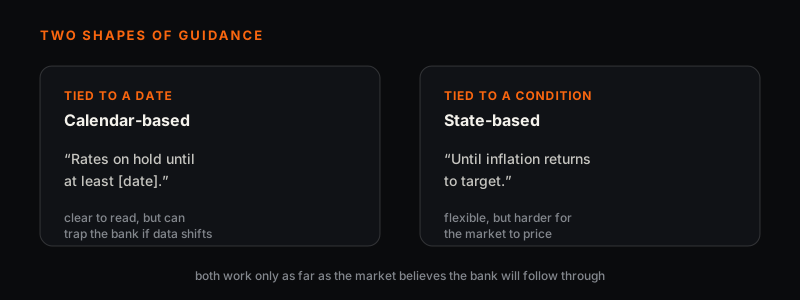
Calendar-based, or time-based, guidance ties the path to the clock. The bank signals that policy will stay at a certain setting until a particular period. It is clear and easy to read, but it can trap the bank if conditions change faster than the calendar.
State-based, or data-based, guidance ties the path to conditions instead. The bank signals that it will hold or move once some economic threshold is met, such as inflation returning to a target or the labour market reaching a certain state. It is more flexible, because it lets the bank respond to the data, but it is also harder for the market to price, because everyone has to judge when that condition will be met.
Guidance also ranges from qualitative, a general lean in the language, to quantitative, a specific numerical condition. The more specific it is, the more powerfully it moves markets, and the more it costs the bank if it has to back away from it.
The catch: it only works if it is believed
Forward guidance runs entirely on credibility. It is a promise about the future, and a promise is only worth anything if the market believes it will be kept.
If a central bank guides one way and then does the opposite, it damages the credibility of everything it says afterwards, and its future guidance stops moving markets as much. That is a real cost, and it is why some central banks, and some of the people who run them, deliberately keep their guidance vague or downplay it, preferring to retain the flexibility to react to the data over the power of a firm commitment. A bank that has boxed itself in with specific guidance and then needs to change course faces an awkward choice, and markets know it.
So when I read guidance, I weigh it against the bank’s track record. Guidance from a bank that has followed through before carries real force. Guidance from one that has reversed itself recently carries a discount.
How I read it
At and between meetings, I watch for shifts in guidance more than the decisions themselves, because a change in the signalled path is often the real market-mover, as I described in how to read a central bank meeting. A bank adding, dropping or altering its guidance is telling me the expected path has changed, and that is what the currency trades.
Then I fold it into the wider read. Guidance that steers the path in a direction my other evidence already supports is strong corroboration. Guidance that fights the positioning and the data is a tension worth respecting, which is the approach in how corroboration works.
In WatchTower Terminal I keep each central bank’s stance and expected rate path in one view, so a shift in guidance shows up as a change in the path rather than a line buried in a statement.
Forward guidance is the central bank talking its way to an outcome before it has to act. Read the words as policy, watch for when they change, and always ask whether the market has reason to believe them.
Reading this is one thing. Seeing it live is another.
The composite score on 24 markets, positioning across 44, and the research consensus behind them. 12 boards free, no card.