Getting Started
How Corroboration Works: Reading Positioning, Research and Rates Together
No single signal is reliable on its own. The real edge in macro is corroboration, when independent reads all point the same way. Here is how I layer them.
If there is one idea that sits underneath everything I do, it is this. No single signal is reliable on its own, and the edge comes from corroboration, the moments when several independent reads all point the same way. This piece is the method behind the rest of the research on this site, so it is a good place to start.
Why one signal is never enough
Every indicator I use has a failure mode. Positioning data is stale and covers only part of the market. Research consensus can be crowded and wrong at exactly the wrong moment. A rate differential can be overridden by a wave of risk-off flows. Seasonality is a tendency, never a certainty. Each of these reads is useful, and each one, on its own, will get you badly hurt if you trust it alone.
The reason is that any single signal can fire by chance or reflect one narrow slice of what is happening. The question I care about is whether a view survives contact with evidence that has nothing to do with it. When it does, I have something worth acting on. When it does not, I have a hunch dressed up as a thesis.
The layers I read
I think of the market read as a stack of independent layers. The value is in how they line up, so I look at each in turn and then step back.
The macro and rate driver. This is the backbone, the fundamental force that should move a currency over weeks and months. Where do policy rates sit, and more importantly, how is the expected path shifting. This is the starting point, and I covered it in rate differentials explained.
Research consensus. This tells me where the weight of informed institutional opinion sits, and how tightly it clusters. It is a base rate for my own view to agree with or argue against, and the dispersion tells me whether a view is crowded or genuinely debated. I wrote about reading it in bank research consensus.
Positioning. This tells me how the speculative crowd is already leaning and, crucially, how stretched it is. Light positioning behind a good macro case is fuel. Stretched positioning is a warning. The full method is in how to read the COT report.
The risk regime. Sitting over all of it is the market’s appetite for risk, which decides whether the fundamental layers are in charge today or whether fear has taken the wheel. I covered that in risk-on, risk-off.
What corroboration looks like in practice
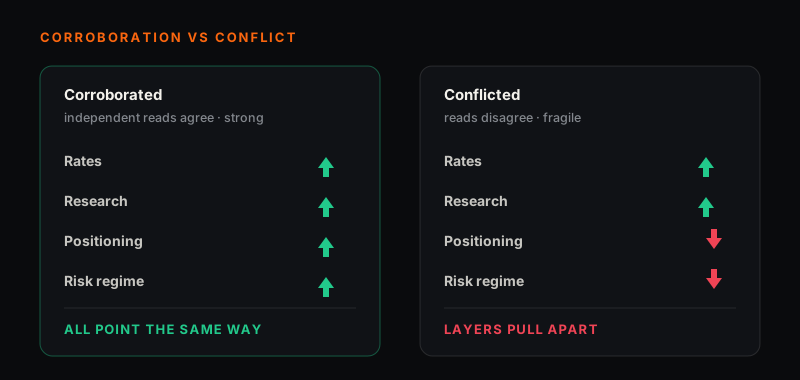
Take a currency where the rate path is turning genuinely more supportive. On its own, that is a reasonable start and nothing more. Now suppose research consensus is leaning the same way, the speculative crowd is still lightly positioned rather than piled in, and the broader risk backdrop is calm. Four independent reads agree, and none of them needed the others to be true. That is a corroborated view, and it is the kind of setup I want.
Now change one thing. Same improving rate path, same consensus, but positioning is already stretched to an extreme and the risk mood is fragile. The fundamental case has not changed at all, and yet the trade is now far more dangerous, because the crowd is already there and the environment is primed for an unwind. The layers are in conflict, and conflict is a signal to stand down or size small.
The difference between those two situations is invisible if you only look at one layer. It is obvious the moment you look at all of them together.
Why disagreement is as useful as agreement
I want to be clear that conflict between the layers is not a problem to be smoothed over. It is information. When the rate story says one thing and positioning says another, that tension is telling me the trade is fragile, or that the market has already priced what I am seeing. Some of the most valuable reads come from noticing that the layers disagree, because that is where crowded consensus and stretched positioning quietly set up the next reversal.
The goal is never to force the layers into agreement. It is to see clearly when they agree and when they do not, and to size my conviction to match.
Bringing it into one view
This is the whole reason WatchTower Terminal exists in the shape it does. Reading these layers one at a time across four different screens is slow, and by the time you have assembled the picture the moment has often passed. The platform puts the rate and macro read, the research consensus, the positioning and the risk backdrop for each asset in one place, so the corroboration, or the lack of it, is visible at a glance rather than reconstructed by hand.
That is the method, and it is deliberately unglamorous. I am not looking for a single magic signal, because I do not believe one exists. I am looking for the moments when independent evidence converges, and I am at my most careful when it does not. Everything else on this site is just the individual layers explained in detail. Start with whichever one you want to understand first, and read them as a set.
Reading this is one thing. Seeing it live is another.
The composite score on 24 markets, positioning across 44, and the research consensus behind them. 12 boards free, no card.