FX Fundamentals
What Moves the US Dollar
The dollar sits on one side of most FX trades, so understanding it matters more than any other currency. Here are the forces that actually move it, and the dollar smile.
The dollar sits on one side of most currency trades, so if there is one currency worth understanding properly, it is this one. When the dollar moves, it moves against almost everything at once, which means a view on the dollar is really a view on half the FX market. Here is how I think about what drives it.
Why the dollar is different
The dollar is the world’s reserve currency. It is the currency most global trade is invoiced in, the currency most cross-border debt is issued in, and the deepest, most liquid market on the planet. That status gives it a property no other currency has to the same degree. When the world gets frightened, it runs toward the dollar for safety, regardless of what is happening in the US economy itself.
Most people track the dollar through the dollar index, which measures it against a basket of major currencies. The index is heavily weighted toward the euro, so in practice a lot of what looks like a dollar move is really the euro moving on the other side. That is worth remembering, because the dollar is always strong or weak against something specific, never in the abstract.
The forces that drive it
A handful of forces do most of the work.
Relative interest rates. The single biggest driver over the medium term is where US rates sit and, more importantly, where the Federal Reserve is expected to take them relative to other central banks. If the Fed is expected to hold rates higher for longer than its peers, capital is drawn toward the dollar. This is the rate-differential story applied to the dollar, and I covered the mechanism in rate differentials explained.
Risk sentiment. Because of its safe-haven role, the dollar tends to rise when the world moves into risk-off and fear takes over. In those moments capital floods toward dollar liquidity and safety, and the dollar can rally even when US fundamentals are unremarkable. I covered that regime in risk-on, risk-off.
Relative growth. Currencies respond to the relative strength of economies. When the US is clearly outgrowing the rest of the world, capital is pulled toward US assets and the dollar with them. When the rest of the world is catching up or pulling ahead, that flow reverses.
Global dollar funding. Because so much of the world borrows in dollars, periods of financial stress create a scramble for dollars to meet those obligations. That funding demand can push the dollar sharply higher in a crisis, on top of the safe-haven flows.
The dollar smile
The most useful mental model I know for the dollar is the dollar smile. It explains why the dollar can strengthen for two completely opposite reasons.
Picture a smile-shaped curve. On the left side, the dollar is strong because the US is outperforming, with stronger growth and higher relative rates pulling capital in. On the right side, the dollar is also strong, but for the opposite reason, because the world is in a risk-off panic and everyone is running to dollar safety. In the dip in the middle sits the dollar’s weak zone, where global growth is healthy, risk appetite is good and there is no crisis, so capital happily leaves the US in search of better returns elsewhere.
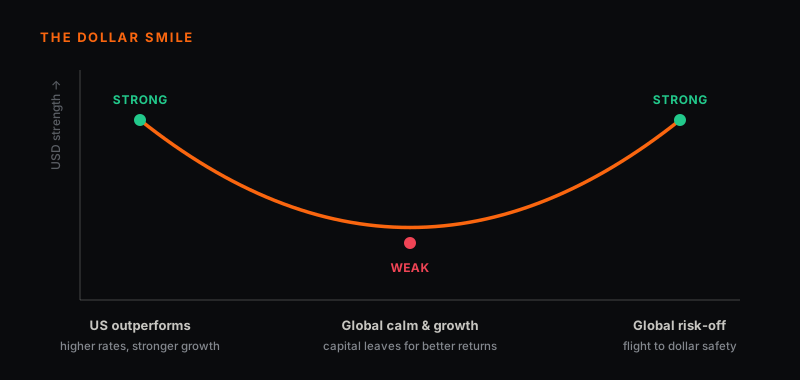
The practical value of the smile is that it forces you to ask which part of the curve the market is in before you interpret a dollar move. A rising dollar driven by US strength is a very different animal from a rising dollar driven by global fear, and they tend to behave differently against different currencies.
How I read the dollar
I start by asking which part of the smile we are in. Is the dollar being bid because the US is outperforming and the Fed is leaning higher than its peers, or because the market is frightened and reaching for safety, or is it soft because the world is calm and growth is broad. That single question frames everything else.
From there I watch the relative rate path between the Fed and the other major central banks, and I keep the risk regime in view, because those two forces do most of the heavy lifting. When the rate story and the risk story agree, the dollar move tends to be durable. When they pull in opposite directions, I expect a choppier, less trustworthy move. That is the corroboration approach I described in how corroboration works.
In WatchTower Terminal I keep the dollar’s relative rate picture, the macro backdrop and the risk regime in one view, so I can place a dollar move in the right part of the smile rather than react to the index in isolation.
The dollar is the water the whole FX market swims in. Get the dollar right and half of your currency views take care of themselves. Get it wrong and no amount of work on the other side of the pair will save the trade.
Reading this is one thing. Seeing it live is another.
The composite score on 24 markets, positioning across 44, and the research consensus behind them. 12 boards free, no card.